
Successful Forex Trading Strategies for New Traders (2026 Guide
Many beginners fail because they overcomplicate their charts with dozens of indicators. Success in Forex is rarely about finding the “magic” signal; it is about mastering a simple, repeatable strategy that aligns with market structure and disciplined risk management.
Disclosure: This article contains affiliate links. If you choose to sign up or trade with any of the platforms mentioned, I may receive a commission or referral fee at no extra cost to you. This does not influence my analysis, which is based on my own experience as a trader. Please remember that forex trading involves a high level of risk and may not be suitable for all investors.

Brian Rosemorgan
Retired Professional Trader | 8+ Years Experience | South Africa
Questions? WhatsApp me directly →
Overview
Successful forex trading strategies for new traders focus less on finding a “perfect” indicator and more on following simple, repeatable methods with strong risk management. Most beginners achieve better results by trading with the trend, using support and resistance levels, waiting for clear price action signals, and risking only a small percentage of their account on each trade. Professional traders prioritize consistency and capital preservation over quick profits.
Common beginner-friendly strategies include trend-following, breakout trading, support and resistance trading, and price action setups. These approaches work best when combined with a trading plan, proper position sizing, and emotional discipline. New traders should avoid overtrading and focus on mastering one strategy before experimenting with more advanced techniques.
The most successful forex traders understand that profitability comes from consistency rather than prediction. A simple strategy, applied with patience and sound risk management, is often more effective than using multiple indicators or constantly changing trading methods.
- Tokyo: 00:00 — 08:00
- London: 09:00 — 15:00
- Overlap: 15:00 — 17:00
- New York: 17:00 — 00:00
💡 Test Your Strategy Risk-Free First
Don’t risk real South African Rands while learning these five setups. Professional traders use Demo Accounts with virtual funds to safely test execution speed, chart patterns, and stop-loss rules under real live market conditions.
AvaTrade Demo
Best for practicing advanced risk controls & automated copy-trading setups.
Affiliate Disclaimer: Registering for a free virtual account via these links supports our educational content at no extra cost to you. Demo accounts contain zero financial risk.
why do trading strategies fail
Disclaimer: Trading involves significant risk. I receive a commission if you sign up through these links at no extra cost to you. Only trade with capital you can afford to lose.
Core Strategies for Beginners
Risk Management Rules Every Beginner Must Follow
Risk 1–2% Per Trade: Never expose more than a tiny fraction of your account to a single market move. This “1% rule” ensures that a string of losses will never wipe out your capital, giving you the runway needed to survive and eventually profit.
Always Use Stop Losses: A stop loss is your non-negotiable insurance policy. It automatically exits a losing trade, preventing emotional attachment from turning a small, manageable error into a catastrophic account-destroying event. Market uncertainty is constant; your exit strategy must be mechanical.
Maintain a 1:2 Risk/Reward Ratio: Aim to make twice as much as you risk on every trade. This allows you to remain profitable even with a win rate below 50%. It transforms trading from a guessing game into a mathematical advantage where your winners consistently outweigh your losers.
Avoid Overtrading: Trading is about quality, not quantity. Overtrading often stems from boredom or the desire to “make back” losses quickly. Stick to your high-probability setups and wait for the market to align with your strategy; force-feeding trades rarely results in long-term success.
Keep a Trading Journal: Treat your trades as a business by recording every entry and exit. A journal reveals your behavioral patterns, highlights recurring mistakes, and helps you refine your strategy. You cannot improve what you do not measure, and documentation is the fastest path to professional growth.
1. Price Action Trading
Price action is the art of reading the raw price movement on a chart without lagging indicators. By focusing on candlestick patterns (like pin bars or engulfing candles) at key levels, you learn to read the market’s intent in real-time.
2. Support and Resistance
Every trade begins by identifying horizontal levels where price has historically reacted. Think of these as the “floors” and “ceilings” of the market; buying at support and selling at resistance remains the most reliable foundation for any beginner strategy.
3. Trend Following
The saying “the trend is your friend” is a cliche for a reason. Beginners should avoid trying to pick market tops or bottoms. Instead, identify the higher timeframe trend and only take trades in that direction.
4. Moving Average Crossover
For those who prefer a more systematic approach, the Moving Average Crossover (using the 50 and 200 EMA) is an excellent way to filter for trend direction. When the faster average crosses above the slower one, it signals potential bullish momentum.
5. Breakout Trading
This strategy involves entering a trade when price breaks through a significant support or resistance level with high volume. It is an aggressive but effective way to capture large market moves immediately after a period of consolidation.
| Strategy | Difficulty | Timeframe | Best For |
|---|---|---|---|
| Price Action | Easy | H4/D1 | Beginners |
| Trend Following | Easy | H4/D1 | Swing traders |
| Breakouts | Medium | H1/H4 | Momentum traders |
| MA Crossover | Easy | H1/H4 | Systematic traders |
| Support & Resistance | Easy | H4/D1 | New traders |
Mastering Strategy Execution
Where exactly do I enter?
Enter only when your pre-defined criteria are met with total precision—never guess or chase price. For price action, wait for a confirmed candle close at a key level. For breakout trades, wait for a successful retest to ensure the move is legitimate.
Where is stop loss placed?
Place your stop loss behind a distinct structural pivot point or a recent swing high or low. It should never be an arbitrary distance; it must be positioned where, if hit, your original trade thesis is objectively proven to be incorrect and invalid.
What confirms invalidation?
Invalidation is confirmed when price decisively breaks and closes past your pre-set stop-loss level, indicating the market structure has shifted against your bias. If this happens, accept the loss immediately; never hope for a reversal or move your stop wider to survive.
What is ideal timeframe per strategy?
Use the 4-hour (H4) chart for swing trading to capture broader moves with minimal market noise. For trend-following, the Daily (D1) timeframe offers superior reliability. Scalping-style strategies are best restricted to 5-15 minute charts to allow for the necessary speed of execution.
What I learned after 8 years in the market
After 8 years, I learned that a strategy is only as good as the trader executing it. I wasted years looking for the perfect indicator before realizing that the simplest strategy—Price Action combined with solid Risk Management—was the only one that survived the test of time. I learned that your entry is the least important part of the trade; your stop-loss and position size are what actually keep you in the game.
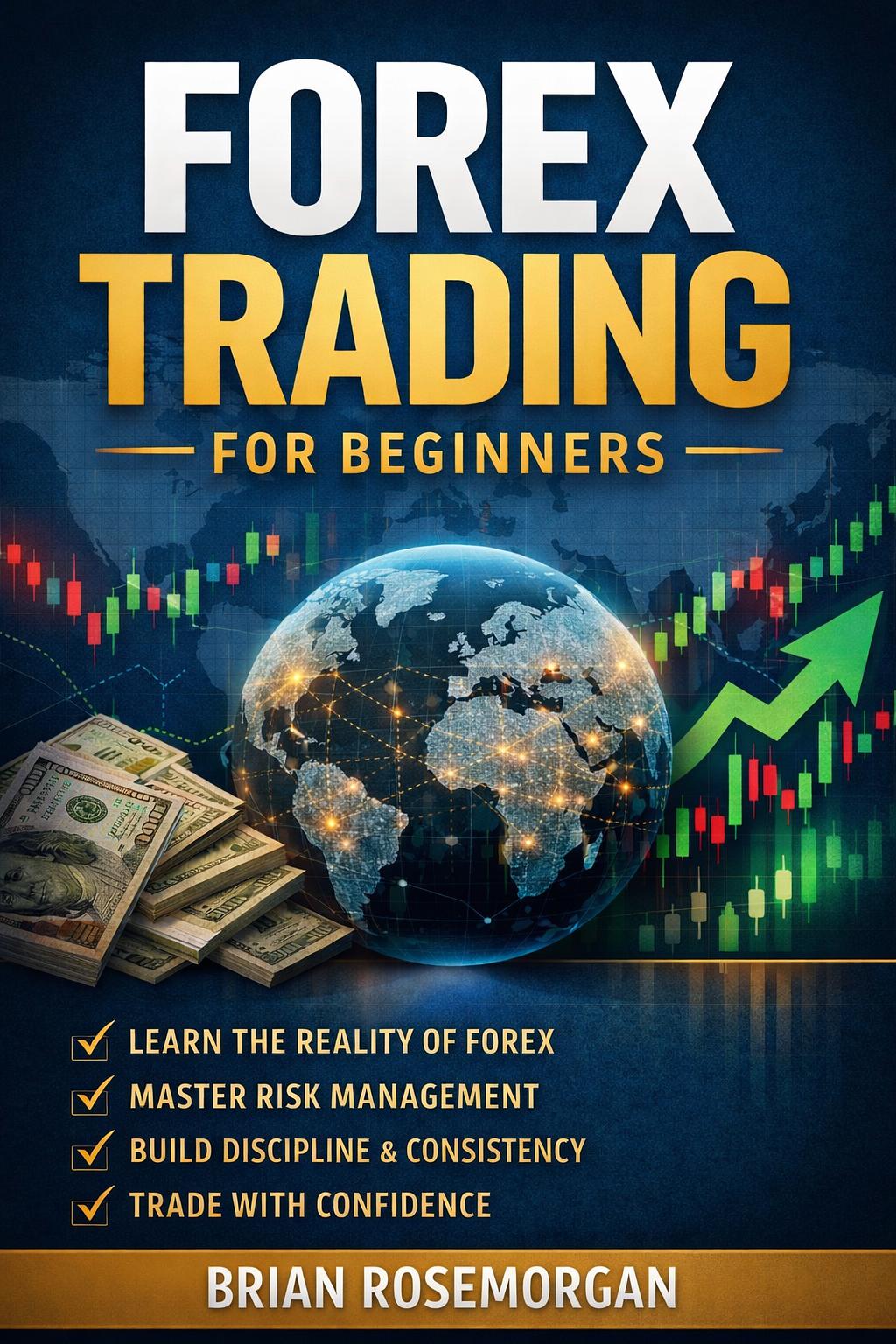
Get The Book
Learn from 8 years of trading experience. Get the exact blueprint used to navigate the markets successfully.
Frequently Asked Questions
1. What is the best timeframe for beginners?
The 4-hour (H4) and Daily (D1) charts are best. They produce less “noise” than lower timeframes and allow for more calculated decision-making.
2. How many indicators should I use?
Keep it to a maximum of two. Over-complicating your charts leads to “analysis paralysis,” where you are unable to pull the trigger because indicators are giving conflicting signals.
3. Is scalping good for beginners?
No. Scalping requires intense focus and rapid decision-making, which usually leads to high-stress, high-frequency losses for new traders.
4. How do I define a “good” trade?
A good trade is one that aligns with your strategy and is executed according to your plan—even if it results in a loss.
5. Should I follow trading signals?
Avoid them. You learn nothing by following others, and if the provider disappears or changes their style, you will be left without a way to trade for yourself.
6. What is Risk/Reward ratio?
It is the amount you are willing to lose versus what you expect to gain. A 1:2 ratio means for every R1 you risk, you aim to make R2.
7. How do I start backtesting?
Go back through past chart data and see how your strategy would have performed. If it doesn’t work in the past, it won’t work in the future.
8. Why is position sizing so important?
It allows you to control your risk regardless of how much capital you have. It is the mathematical way to prevent a single bad trade from wiping out your account.
9. How long until I am profitable?
There is no fixed timeline. It depends on your dedication to the learning process, your journaling habits, and how quickly you can master your own psychology.
High Risk Investment Warning: Trading foreign exchange (Forex) on margin carries a high level of risk and may not be suitable for all investors. The possibility exists that you could sustain a loss of some or all of your initial investment and therefore you should not invest money that you cannot afford to lose.
Educational Purposes Only: All content provided on TryBuying.com is for educational and informational purposes only. Brian Rosemorgan is a retired trader sharing personal experience; he is not a financial advisor. Nothing on this website should be construed as financial or investment advice.
© 2026 TryBuying.com – Built for South African Traders. All Rights Reserved.