This guide shows you how to start forex trading step‑by‑step — without scams, hype, or shortcuts.it was updated in april 2026 by Brian Rosemorgan a qualifyed forex trader with over 8 years of practical experence
📌 How to Start Forex Trading (Quick Answer)
To start forex trading in South Africa, follow these steps:
- Learn the basics – Understand currency pairs, pips, and how trades work
- Choose a regulated broker – Use FSCA-regulated platforms for safety
- Open a demo account – Practice trading with no risk
- Learn risk management – Never risk more than 1–2% per trade
- Start small on a live account – Trade with real money only after practice
Forex trading is not a get-rich-quick system. Success comes from discipline, risk control, and consistent learning.
How Long Does It Take to Learn Forex?
Most beginners take 3–6 months to understand the basics and 6–12 months to become consistently disciplined.
1. What is Forex Trading?
Forex trading is the process of buying and selling currencies to make a profit. Currencies are traded in pairs, meaning you are always exchanging one currency for another.
While the concept sounds simple, real success comes from understanding how the market moves, how risk works, and how to stay disciplined.
If you want to understand how price actually moves, start with Forex Market Analysis.
2. How Forex Trading Works
Before placing your first trade, you need to understand the basic building blocks of the market:
Currency Pairs: Every trade involves two currencies. One is bought while the other is sold.
Pips: A pip measures price movement and determines your profit or loss.
Lots: This is the size of your trade. Larger lot sizes increase both profit potential and risk.
Leverage: Allows you to control larger positions with smaller capital — but increases risk.
Understanding these concepts is essential before moving forward, especially when combined with proper Risk Management.
3. Step‑by‑Step: How to Start Trading
Step 1: Learn the Basics
Start by building a strong foundation. Many beginners rush into trading without understanding how the market works.
This leads to confusion, poor decisions, and unnecessary losses. Take time to learn first — it will save you money later.
Step 2: Choose a Broker
Your broker is your access to the market. Choosing the wrong one can create problems even if your strategy is good.
Use a regulated broker and understand how they operate. Read our full guide on How to Choose a Forex Broker.
Step 3: Practice on a Demo Account
Never start with real money. A demo account allows you to practice in real market conditions without risk.
This is where you build confidence and test your understanding. You can also improve by using tools like the Forex Demo Contest.
Step 4: Learn Market Analysis
To trade effectively, you need to understand how to read charts and identify opportunities.
Start with core concepts like Trend Analysis and Support & Resistance.
Step 5: Use Risk Management
Protecting your capital is more important than making profits early on.
Most beginners fail because they risk too much. Learn how to control your exposure in the Forex Risk Management Guide.
4. Why Most Beginners Lose Money
Most traders do not fail because forex is too complicated. They fail because they approach it without structure.
- No proper education
- No risk control
- Emotional decision‑making
- Following signals or hype
These problems are closely linked to mindset. Learn how to avoid them in Trading Psychology.
5. Forex Trading in South Africa
Forex trading is legal in South Africa, but safety depends on your broker and your knowledge.
Always use regulated brokers and avoid unrealistic promises. If a platform guarantees profits, it is a major red flag.
For local traders, see Forex Brokers with ZAR Accounts.
6. Best Time and Market Conditions
Timing plays a major role in trading success. Some sessions offer more volatility and better opportunities.
Learn when to trade using Best Time to Trade Forex and Best Trading Hours Guide.
7 Quick-Start: Trading Forex with $100 (Reality Check)
Can you start forex trading with $100?
Yes — but focus on learning, not making money.
Most beginners lose money early because they risk too much.
Start small, use micro-lots (0.01), and risk only 1% per trade.
⚙️ Minimum Setup for a $100 Account
- Broker: FSCA-regulated, ZAR account (avoid extra fees)
- Lot Size: Micro (0.01 lot)
- Leverage: Keep it low (max 1:30)
- Risk Per Trade: 1% (≈ R1 per trade)
- Goal: Break-even in your first year
📈 Your Learning Roadmap
Months 1–3
👉 Demo account only — learn the basics
Months 4–12
👉 Trade a small live account ($100)
👉 1–2 trades per week
👉 Track every trade
Year 2+
👉 Grow your account slowly
👉 Focus on consistency, not speed
❓ Common Questions
What’s the minimum deposit in South Africa?
Around R100–R500 with most brokers.
Best pairs for beginners?
EUR/USD and USD/ZAR (good liquidity, lower spreads)
How much can I make?
Expect small gains at first — focus on learning, not income.
Can I practice for free?
Yes — use a demo account before risking real money.
💡 Pro Tip
Before going live, complete at least 50 demo trades and track your results.
👉 Learn proper risk control in your Risk Management guide
Final Thought
Forex trading is not about quick profits. It is about building a skill over time.
Focus on learning, protect your capital, and stay consistent. The results will follow.
Test Your Skills, Risk‑Free
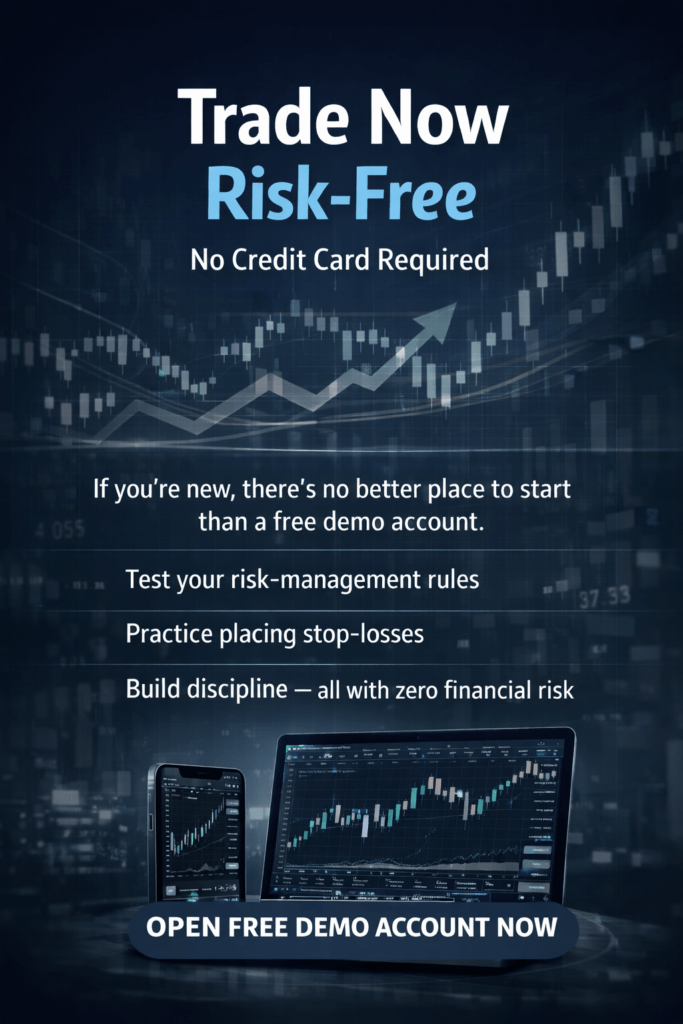
If you’re new, there’s no better place to start than a free demo account. Test your strategies, manage your risk, and trade without pressure — no credit card needed.